
What Kewaunee County Property Tax Records Show
Kewaunee County splits the tax record between two jobs. The Real Property Lister imports assessor changes, prepares assessment notices and rolls, and processes Open Book and Board of Review corrections. That office also calculates the December tax bills. Collection falls to the County Treasurer. The Treasurer receives municipal tax rolls, administers property-tax law, collects payments, handles delinquency and tax-deed steps, and runs the Lottery and Gaming Credit.
| Field | What It Shows | Where |
|---|---|---|
| Assessment attributes | The lister imports assessor changes and prepares assessment notices and rolls. | Real Property Lister / assessor data |
| Tax-bill calculation | The county lister calculates December bills from municipal tax rolls. | Real Property Lister |
| Payment and delinquency | Payment, missed installments and tax-deed procedure. | County Treasurer |
| Lottery and Gaming Credit | The Treasurer administers this credit; current parcel display details should be confirmed. | County Treasurer |
| Open Book and Board of Review | The lister processes assessment changes through these review steps. | Lister and local assessment process |
An assessed value is a taxation figure. It is not a broker's estimate or a guaranteed sale price. Wisconsin's Department of Revenue reports assessment levels by municipality. Pick the right Kewaunee County municipal row. The live search screen does not document its card fields. A land and building split may or may not appear. An exemption code or a last sale price may not appear either. Ask the assessor or lister. Confirm which figures show for the parcel and tax year in question.
Kewaunee County Lister and Treasurer Roles
Kewaunee County splits its property tax work between two offices. The Real Property Lister and the Treasurer both sit in the County Administration Center. Yet their records do not overlap. The lister handles recorded title documents and parcel splits. The office also tracks ownership and mailing addresses, valuation imports, rolls, and tax-bill calculations. The Treasurer collects payments, tracks delinquency, settles with municipalities and runs the county tax-deed process. So who you call depends on the question. A missing owner update belongs to Land Information. A paid installment question belongs to the Treasurer.
The Real Property Listing office sits at 810 Lincoln Street in Kewaunee. It is reachable at (920) 388-7130 on weekdays from 8 a.m. to 4:30 p.m. The Treasurer shares that street address at (920) 388-7131. Either office can route a parcel question. But one office's screen cannot stand in for the other's records. The county's Real Property Listing page describes the lister's assessment and bill tasks. The same Real Property Listing page summarizes the lister's role in the annual roll for Kewaunee County property records work.
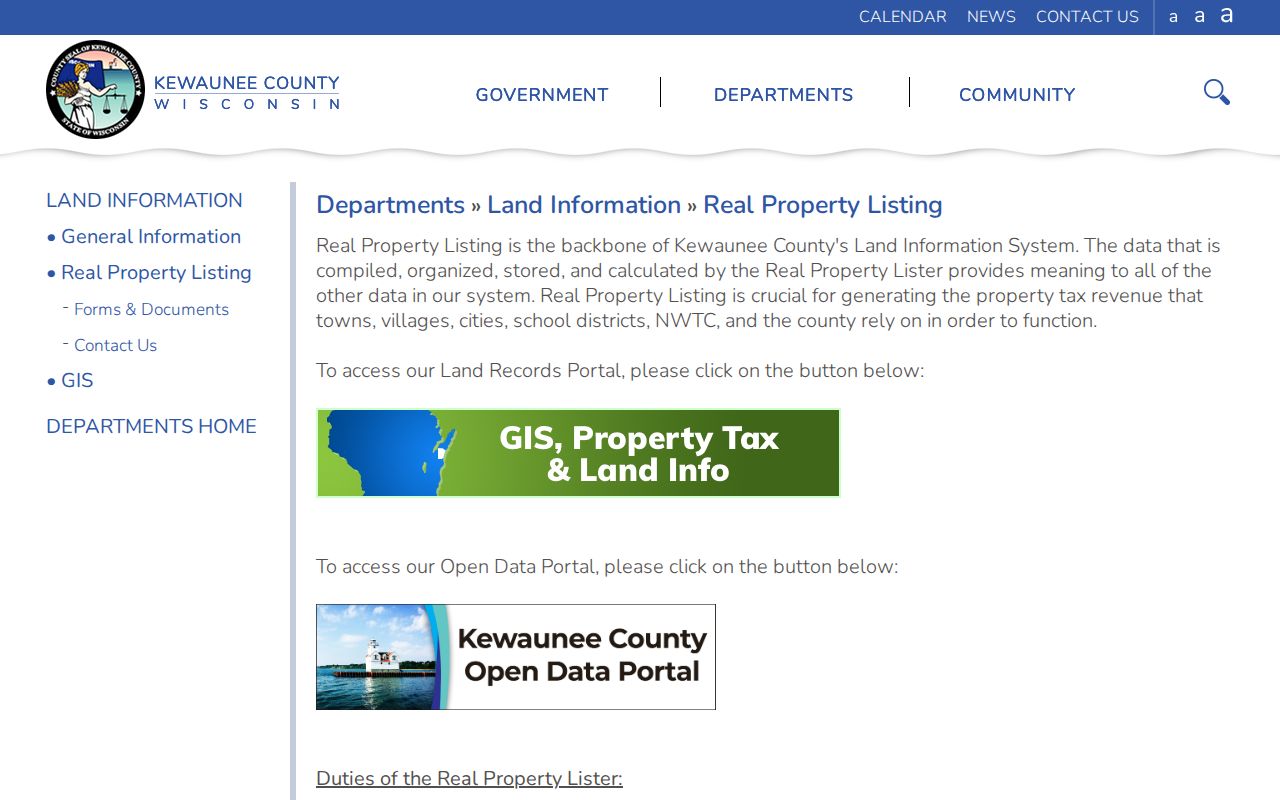
Assessment-roll work and tax collection are related, but each has its own custodian.
Looking Up a Kewaunee County Tax Bill
The Treasurer's property-tax office leads on amount due and payment status. It also handles delinquent balance and the tax-deed process. The county publishes no direct parcel tax-bill search URL. Confirm the current lookup route from the county Treasurer page. Have the property address and parcel number ready. And if a bill never arrives, the county says the payment duty still stands.
- Start with the County Treasurer's tax page and identify the parcel by address or number.
- Ask for the current bill, prior-year balance, payment status and any delinquent amount.
- Check assessment or credit questions with the lister or relevant assessor.
- If a balance is old, ask the Treasurer about current interest, penalty and tax-deed status.
- Assessment roll
- The lister's record of parcel and assessment information used in the tax process.
- Installment
- A scheduled part of a property-tax payment under the county's payment rules.
- Delinquency
- An unpaid amount after the applicable installment due date.
- Tax deed
- A county process for land with severe delinquent taxes; it is distinct from an ordinary payment balance.
The Kewaunee County Treasurer names the office responsible for tax questions. Contact and payment details live on the county's Treasurer's office page.
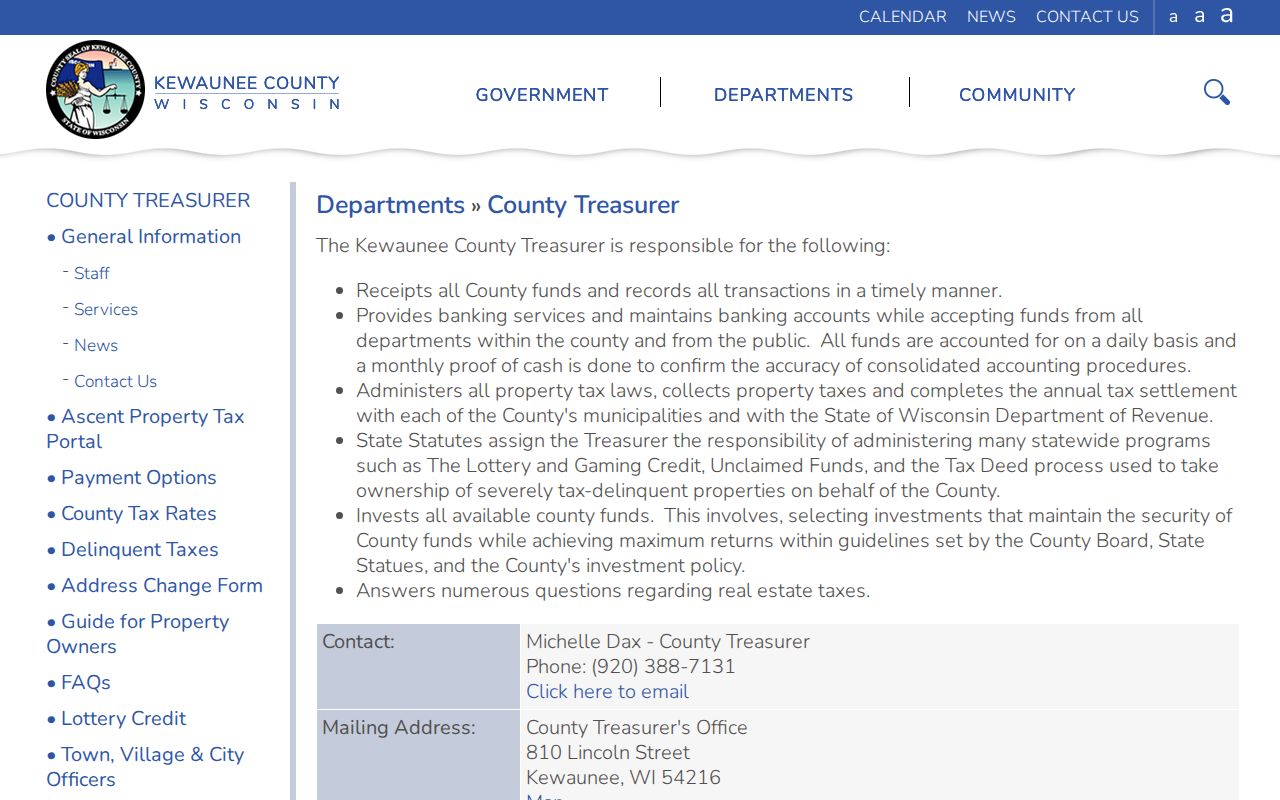
Bill and payment questions go to the Treasurer.
Kewaunee County Tax Installment Dates
The county Treasurer explains two delinquency points for current-year property taxes. The first installment or full payment is due January 31; an unpaid first installment becomes delinquent February 1. The second installment is due by July 31; an unpaid second installment becomes delinquent August 1. The county page describes monthly interest and penalty, while the Treasurer FAQ also explains payment arrangements and receipts. Use the current notice for a live amount because rules and balances can depend on the tax year and parcel.
Wis. Stat. §§74.11 and 74.12 are cited on the county delinquent-tax page. Prior-year delinquent taxes are paid to the county Treasurer. The county's notice says missed installments are subject to 1% monthly interest plus an additional 0.5% monthly penalty. If an installment was missed, ask for the payoff figure and payment instructions before relying on a rough calculation.
The county's delinquent-tax page sets out the local due dates and process.
The county's delinquent-tax page explains how late balances move into delinquency.
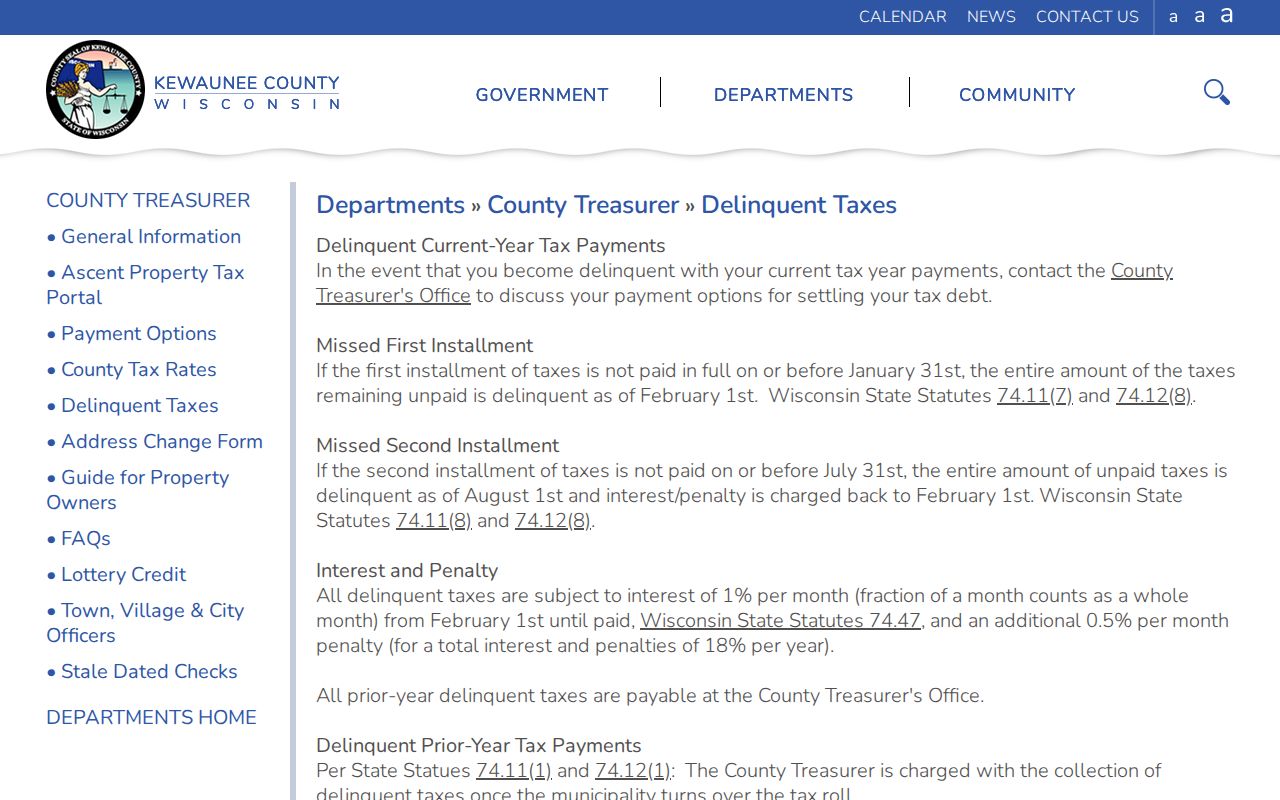
Confirm the current parcel balance with the Treasurer before paying or planning a sale.
Kewaunee County Tax Credits and Assessment Rolls
The County Treasurer runs the Lottery and Gaming Credit. Credit questions go there. Assessment-roll questions go to the lister or local assessor. No county source spells out every credit, exemption field, or eligibility rule on the parcel card. Do not assume a credit is present. A field on another year's bill does not make it current.
The Wisconsin Department of Revenue publishes municipal Statement of Assessment, aggregate-ratio, and major-class reports. They help compare a Kewaunee County municipality against its tax year. A countywide figure should not describe one city or parcel. One parcel is not a county average. A statewide assessment manual defines assessment level and ratio. It will not judge one property's value.
When a bill or notice misses expectations, start with the parcel number and tax year. Then contact the office responsible for that figure.
Delinquent Kewaunee County Tax-Deed Records
The County Treasurer administers a tax-deed process for severely delinquent parcels. County Ordinance Chapter 5 addresses county acquisition, publication and sale of tax-deeded land. It gives former owners a preference to repurchase under Wis. Stat. §75.35(3), and the county's March 2026 finance agenda describes publication within 180 days for land acquired on or after January 1, 2026, with possible open or closed bid or broker sale. Check current adopted rules before acting on an old notice.
To trace a completed transfer, compare the Treasurer's notice or agenda with the recorded tax deed and current lister entry. A delinquent balance alone does not establish that the county took title. Foreclosure case leads may appear in WCCA, but the court file and recorded instrument provide the proof of later action.
The 2026 agenda is a recent procedural clue; the Treasurer's current page remains the first source for a parcel balance.
Reviewing a Kewaunee County Assessment
The Real Property Lister enters Open Book and Board of Review changes, but Kewaunee County publishes no single countywide appeal date or shared deadline across its municipalities. Each town and city sets its own calendar. Read the assessment notice and the local assessor's instructions for the meeting date, filing steps, and evidence rules that apply to the parcel's jurisdiction. When questioning a discrepancy, bring a clear legal description and the parcel number, and weigh the parcel's assessment attributes against similar land and improvement records from the same year.
Review window. Kewaunee County's source material confirms Open Book and Board of Review changes but does not publish a single date for every jurisdiction. Read the notice and contact the local assessor or lister promptly to confirm the right filing date and process.